

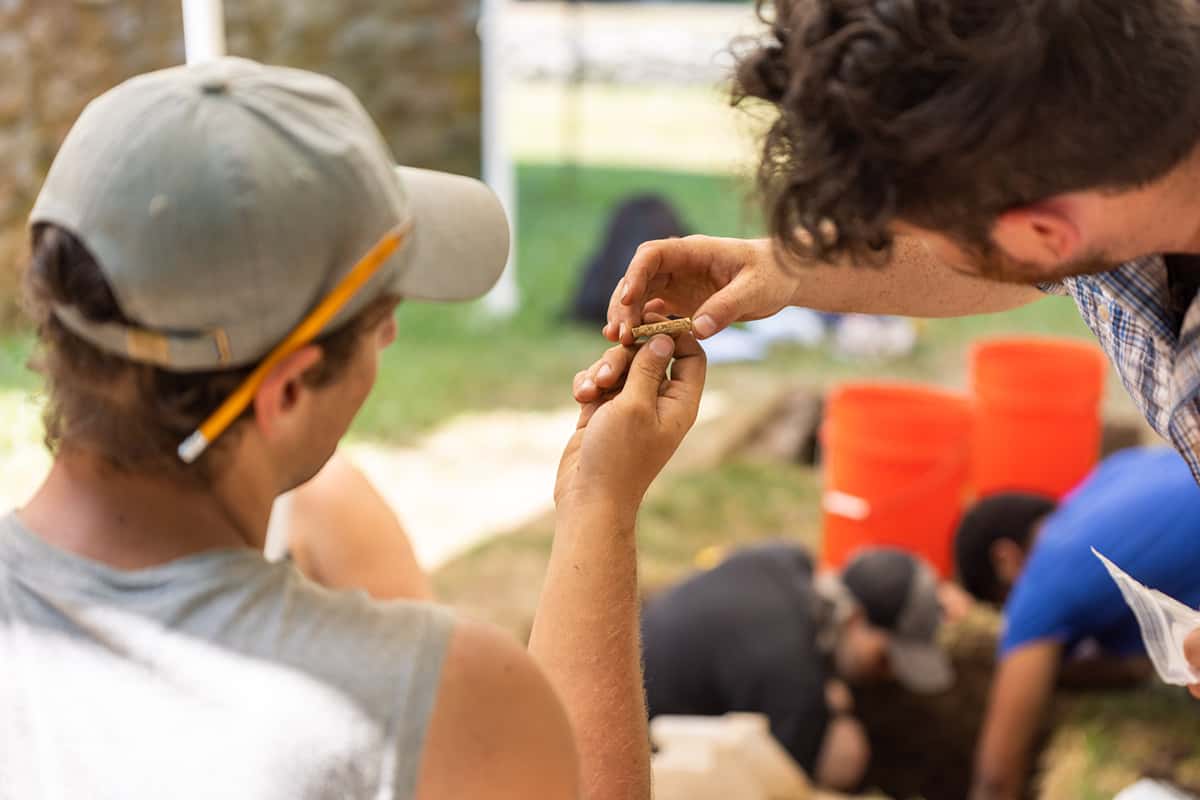
IT’S A DAPPLED-SUNSHINE, PICTURE-PERFECT FALL DAY and Michael Rogers, professor of anthropology, is leading about a dozen undergraduate and graduate students down Huff-Puff Hill at West Rock Nature Center in Hamden. Carrying blue plastic tarps, buckets, shovels, and other tools, they travel to Field Site 6225, the home base for Rogers’ Field Methods in Archaeology course.
In fall 2025, Southern launched a master’s degree program in archaeology and cultural resource management. As a result, for the first time, Rogers is simultaneously teaching Field Methods at both the undergraduate and graduate levels.
The graduate program is a rarity in New England, established to meet student requests and workforce need. “There are people working in the field who want to move up the career ladder . . . to take on a supervisory role or be authorized to sign off on paperwork,” says Rogers.


Mention archaeology and many imagine an exotic scene from Indiana Jones. But archaeologists are also needed close to home for development projects (roads, buildings) and land-use planning — especially when there is a risk of disturbing cultural heritage.
“Preservation is a whole industry,” says (above, far right) Trevor Kincaid, a member of the first graduate cohort. In addition to cultural resource management, an advanced degree opens doors to leadership work in museums and local, state, and federal heritage agencies, among others.
Kincaid, who earned his undergraduate degree in the field, works with Yale University’s Department of Anthropology. “I love that we have this master’s program that is local instead of having to leave the state or pursue a Ph.D., which is a huge commitment,” he says. “It’s a great way to get your hands dirty and gain experience without trekking across the country and uprooting your whole life.”
Graduate students Charlie Robichaud and Natalina Portillo Corrales agree. Both plan to eventually earn doctoral degrees and pursue careers as college professors. Robichaud is interested in zooarchaeology, the study of animal remains, while Corrales is focused on human origins. Although the field site at West Rock Nature Center doesn’t yield all types of artifacts, Robichaud values the opportunity to gain excavation and site-management experience. Corrales, meanwhile, found the course essential preparation for fieldwork abroad.


The course got off to an auspicious start with a field trip. The first day of class, everyone traveled to the top of West Rock Ridge State Park to visit Wintergreen Notch, an archaeological site high above the Wilbur Cross Parkway tunnel. About 25 years ago, anthropologist Cosimo Sgarlata was hiking in the area when he recognized rock fragments. An excavation followed, revealing what Sgarlata, who died in 2022, believed was a hunting camp, a glimpse of life some 4,000 years ago.
“He discovered these projectile points in large concentrations,” says Rogers, “and when we went up last fall, we found one of these points. It is mostly intact, which was very exciting and not something that happens often.”
Down the road, the search continued throughout the semester at West Rock Nature Center, where Rogers has taught Southern students for more than 20 years. Meeting once a week for each day-long session, students practice techniques used by archaeologists throughout their careers: gridding (dividing the site into a measured grid system using a fixed reference point for three-dimensional mapping); hand excavation (the precise removal of soil to expose fragile artifacts); recording and documentation; sieving all excavated soil to recover small artifacts; conservation techniques; and more.

Artifacts found at the site date from the Late Archaic period, between 5,000 to 2,000 years ago, left behind by those drawn to the beautiful area. The location — close to water and a historic game trail — made it an attractive spot for ancient communities.
But one resource was scarce: high-quality stone such as chert or flint used to make tools. Quartz, however, was found in abundance. It isn’t easy to work with — the students try their hand at toolmaking early in the course — but thousands of years ago experienced flint knappers used antlers or stones to create tools.
“Ninety-nine percent of what we find are quartz fragments from toolmaking,” says Rogers. “If we are lucky, we also find a finished projectile point — an arrowhead or atlatl dart.”


Master of Discovery
ROGERS IS INTERNATIONALLY RECOGNIZED FOR HIS WORK as co-director of the Gona Paleoanthropological Research Project in Ethiopia’s Afar region — one of the world’s most important archaeological landscapes. For decades, he’s worked alongside co-director Sileshi Semaw, a senior researcher at the National Research Center for Human Evolution in Burgos, Spain.
It’s been a fruitful collaboration. The Gona Project has yielded fossils of hominins (humans and our extinct ancestors who walked upright on two feet) dating back more than 6.3 million years as well as stone tools spanning the last 2.6 million years.
Most recently, Rogers and his colleagues contributed to research that shed light on the face of early Homo erectus, the first hominin species to disperse from Africa. Their findings were published in Nature Communications in December. Karen Baab, a paleoanthropologist at Midwestern University in Arizona and the first author on the article, virtually reconstructed the face of early Homo erectus using a 1.5-million- to 1.6-million-year-old fossil, called DAN5, found at the site in 2000.

Rogers has also co-authored papers in the Proceedings of the National Academy of Sciences and Science Advances on a variety of topics, among them, the discovery of DAN5, the smallest Homo erectus cranium excavated in Africa, which was found with a mix of stone tool technologies.
Rogers has conducted fieldwork in East Africa since 1990 and worked specifically at the Gona Project since 1999. He began bringing promising undergraduates to the expedition in 2007; to date, some 25 Southern students have traveled with him to Ethiopia.
“It’s almost always a mind-blowing, world-changing experience, especially for those who haven’t traveled much,” he says. “I had a student who had never been to New York City. Yet here he was in the Afar region of Ethiopia.”
With the launch of Southern’s graduate program, Corrales joined Rogers for the first time, traveling there in January. They worked at the Kilaitoli complex in the Afar region, a site believed to contain artifacts related to human habitation and burials dating to about 13,000 years ago. As of late 2025, eight to 10 human burials were identified, along with obsidian microliths, ostrich-eggshell and marine-gastropod beads, grindstones, and other artifacts.
Living conditions are basic for the researchers. Temperatures soar to 107° Fahrenheit in the dusty landscape, which includes little tree cover. The crew lives in tents and takes bagged-water showers, traveling in four-wheel-drive Land Cruisers. A pickup truck makes a daily water run to a well about an hour away. “Occasional scorpions and solifuges” — fast-moving, nocturnal arachnids including camel spiders, sun spiders, and wind scorpions — “keep us on our toes,” Rogers notes.
Corrales took it all in stride. She majored in psychology as an undergraduate but has dreamed of studying archaeology since taking an introductory course as a freshman. “I am so excited to do formal research,” she says.
Rogers is equally inspired: “This is a big deal for us. There is so much potential to undertake original research on the Gona archaeological collection, and we hope the new graduate program will be a win-win for both our students and the project overall.” ■
Anthropology Digs
IN ADDITION TO THE GONA PALEOANTHROPOLOGICAL RESEARCH PROJECT in Ethiopia’s Afar region and the field site at the West Rock Nature Center, Southern’s Department of Anthropology offers students numerous opportunities to develop archaeological skills. West Rock Ridge State Park is also a nearby source of inspiration.
• THE 17TH CENTURY HENRY WHITFIELD STATE MUSEUM in Guilford, the oldest house in Connecticut, is a wealth of discovery, yielding Native American tools, colonial items, Victorian remnants (buttons, pins, coins), evidence of animal butchering, and more. Southern’s work at the site is overseen each summer by William Farley, associate professor of anthropology.
• Kathleen Skoczen, professor of anthropology and department chair, offers a summer field school in archaeology in the medieval city of Chester, Poulton in England. The multiperiod excavation site dates to the Mesolithic period. Prior excavations have uncovered a chapel and graveyard. The program is in collaboration with Liverpool John Moores University.
Read more from the Spring 2026 issue of Southern Alumni Magazine.