

Kevin Gilbride, ’74, coached 40 years, 24 of those in the National Football League. He helped turn around Southern’s football program as a head coach, reached the NFL’s highest levels, and won two Super Bowls. And none of it would have happened if he’d followed his father’s advice.
Early Days
Gilbride grew up around coaching. His father, Bernie, a high school math teacher and assistant football and basketball coach at North Haven High — and a graduate of Southern’s predecessor New Haven State Teachers College — understood the demands of the profession. He urged his son to avoid teaching and coaching altogether.
But Kevin admired the life his father had made, especially the positive impact he had on young people, and wanted to follow in his footsteps. So, he enrolled at Southern to major in health science physical education and play football.
His path seemed clear. Gilbride started the opening game of his sophomore season as Owls quarterback. It didn’t go so well, and by the second game, he was second-string. Rather than leave an excellent athlete on the bench (Gilbride had played football, basketball, and baseball at North Haven High), Southern’s then football coach Harry Shay tried Gilbride at tight end, where he started for three seasons. It was the first of two moves Shay made that changed Gilbride’s life.
The second came during Gilbride’s senior year. Shay pulled him aside with advice that would echo for decades: don’t chase high school jobs, aim at the college level. It was easier, Shay told him, to move from coaching college to high school than vice versa. He also suggested Gilbride apply for graduate assistant positions in physical education to get a foot in the door.
“It wound up being the greatest piece of advice I ever got,” Gilbride says.
By then, his father had died at age 45 from a genetic kidney disorder. Gilbride, the oldest of seven children, would have made him proud. Following coach Shay’s advice, he applied for graduate assistantships teaching Phys Ed and coaching football. In all, he sent applications to 107 colleges pulled from a directory Shay had given him.
Joe Paterno at Penn State was interested. But the physical education department didn’t think Gilbride was qualified to teach orienteering, dance, and the martial arts.
He ultimately received two offers: Slippery Rock University and Idaho State University, which he chose because it had the better football program and fellow Southern alumnus Bob Griffin, ’63, was the head coach.
At Idaho State, he also was the co-head coach of the women’s basketball team. Within a year, he was offered the top job outright. It would mean more money, which tempted him and his wife Debbie, who was pregnant with the first of their three children, but Gilbride decided to stick with football.
It was a sound decision, and Gilbride continued to climb the career ladder: he was the linebackers coach at Idaho State as well as Tufts University, then the defensive coordinator at American International College. Each move brought increased knowledge and experience, and in 1980, he returned to Southern as head coach. There, he turned the Owls losing program into one ranked among the top ten in the nation.
Success at Southern
Those five years were memorable. Gilbride was coaching in his hometown, surrounded by extended family, and mentoring players who would go on to the NFL, including Travis Tucker, Kerry Taylor, and Scott Mersereau.
“To be able to coach those kids, to see them grow and develop as young men and prosper in their careers was a sheer pleasure,” he says. “I loved being at Southern when I was a player. I loved it even more as a coach.”
He left after the 1984 season, moving to the Canadian Football League (CFL) for three years, then onto East Carolina University as offensive coordinator. His big break came in 1989, when the Houston Oilers hired him as their quarterbacks coach, drawn in part by his experience with the run-and-shoot offense he’d learned with the Ottawa Rough Riders in the CFL.
He spent five years with Houston as the offensive coordinator then two years with the Jacksonville Jaguars in the same role. The San Diego Chargers hired him as their head coach in 1997 — making Gilbride the first Southern graduate to become an NFL head coach — a position he held for six games into the 1998 season.
He worked with the Pittsburgh Steelers and the Buffalo Bills as an offensive coordinator, then in 2004 began a ten-year run with the New York Giants, where he earned those two Super Bowl rings.
Guiding the Giants
It was period of stunning accomplishments. As the quarterbacks coach, Gilbride worked with Eli Manning, who went on to earn two Super Bowl MVP awards. As offensive coordinator, Gilbride helped guide the Giants to those two Super Bowl victories following the 2007 and 2011 seasons. And, for four years, he also worked alongside his son Kevin, who was the Giants receivers coach.
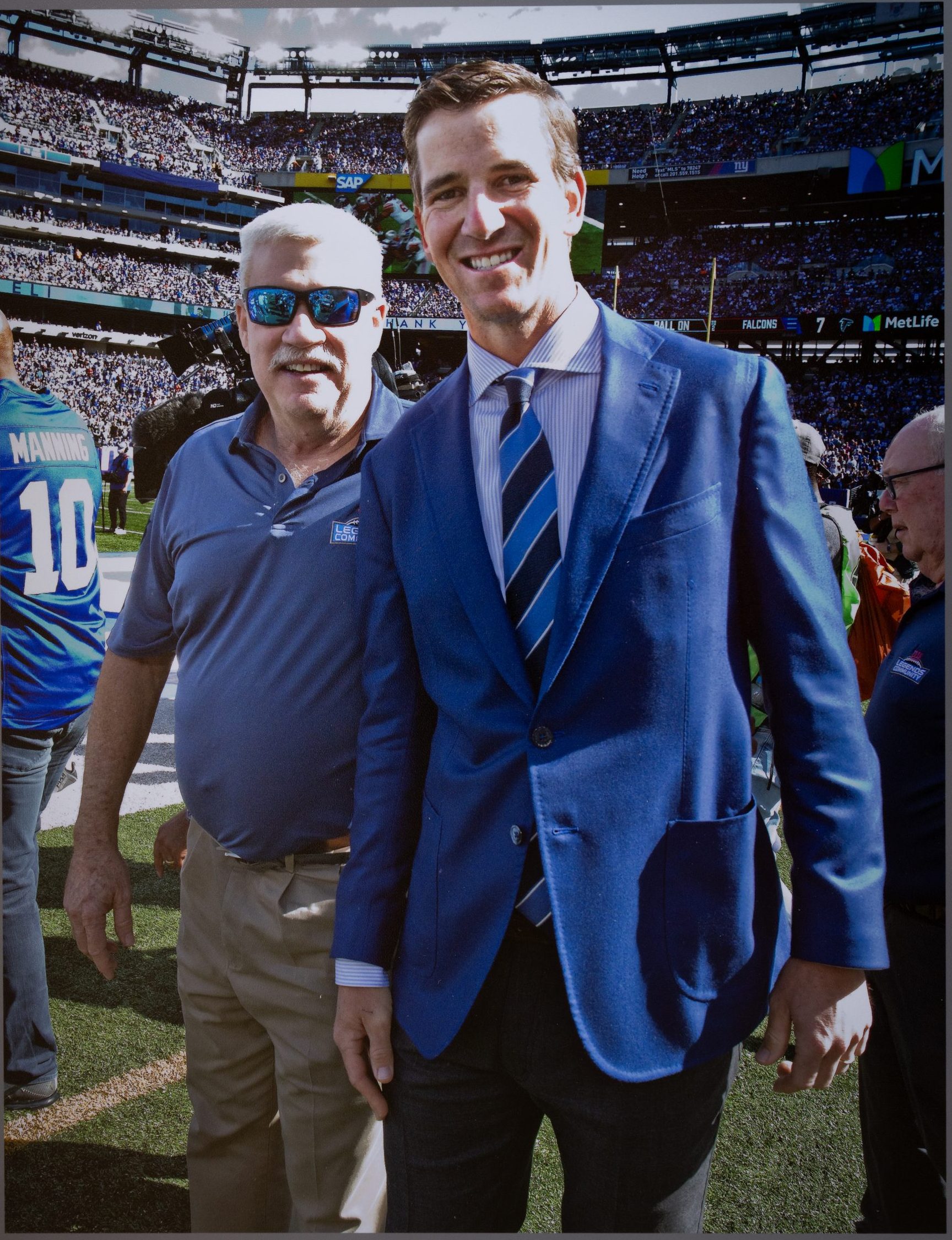
retirement ceremony. Photo: Malcolm Greenaway
“While it’s going on, you don’t recognize how lucky you are. It’s all about doing the job and getting the work done,” he says. “But looking back on it now? Talk about being blessed.”
Gilbride was interested in another NFL head coaching job, but when that did not materialize, his wife encouraged him to retire to spend time with family. He left the Giants after the 2013 season.
Seven years later, he returned as the head coach and general manager of the New Haven Guardians in the upstart XFL, but the COVID-19 pandemic halted the season. The following year, Gilbride spent a season as head coach of the Jousters in The Spring League (predecessor to the UFL), before finally hanging up his coach’s whistle.
Today, he enjoys spending time with his three children, six grandchildren, and wife of 51 years. He and Debbie split their lives between Narragansett, Rhode Island, and Naples, Florida. He also prepares analysis for Monday Night Football broadcasts by watching hours of film.
“It’s a great opportunity for me to stay involved with the game I love so much,” he says.