
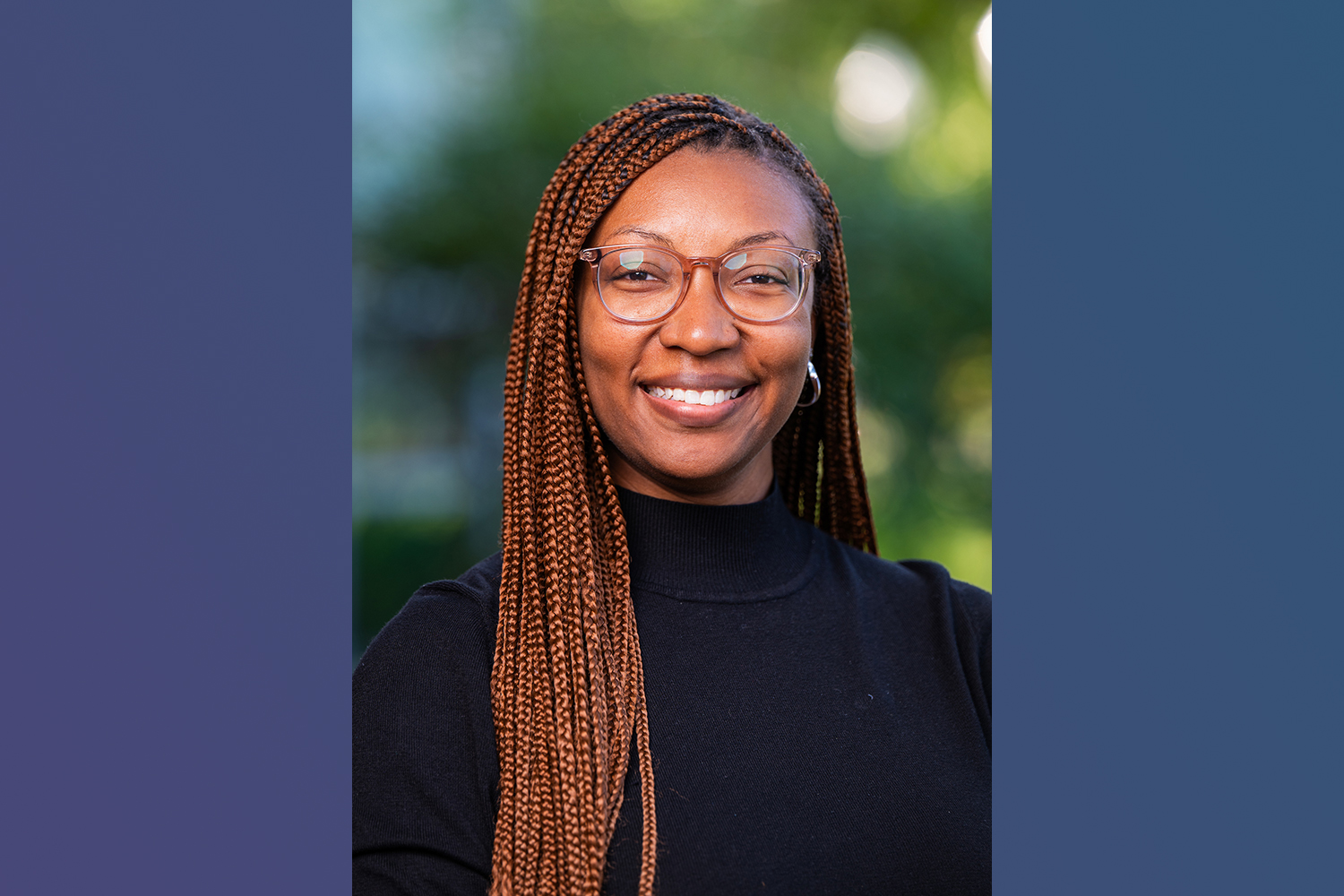
When Dr. Sydney Nelloms stands at the front of a classroom at Southern, the life’s work she’s offering students goes beyond a syllabus. It’s also a lesson in empowerment.
“So many students tell me they’ve never had a Black professor or a queer professor, and I see myself in you,” she said. “People don’t realize how powerful that is—how it can uplift entire communities.”
Nelloms joined SCSU’s Department of Sociology as an assistant professor after earning her Ph.D. in Criminal Justice and Criminology from Georgia State University. Her specialty is queer criminology—a field that examines how LGBTQ+ people move through the criminal justice system as victims, as offenders, and as practitioners.
Growing up in Atlanta, Nelloms experienced firsthand the weight of preconceived negative notions placed on Black queer people. Those experiences planted a research desire: “If I’m going through these things, I can’t be the only one,” she said. “I want to know why this is happening.”
She initially planned to become a lawyer, but during her junior year of college, a professor encouraged her to consider teaching. But she loved criminology. Along the way, her research transformed—from asking why people commit crimes to asking why certain people are so much more likely to become victims.
What she kept finding was a lack of research on Black queer people specifically. “A lot of times, we’re grouped into queer people of color category because there aren’t enough of us to stand alone in the data,” she said. “But our experiences are quite different. I wanted to bring Black queer issues to the forefront.”
Nelloms’s dissertation examined the victimization risks and health outcomes of Black queer college students—a population, she noted, that is statistically among the most likely to experience harm, and yet among the least represented in academic literature. Her research falls under the framework of polyvictimization: when a person experiences multiple, overlapping forms of abuse—physical assault, sexual violence, bullying, family violence—simultaneously or across time.
What she found confirmed what she had suspected: students who identify as queer and experience polyvictimization are significantly more likely to suffer academically than their peers. When race is layered in, the effects compound. “It was important for me to shine a light on why individuals experience certain types of victimization,” she said.
She is equally enthusiastic about dismantling the myths that students arrive with. The popularity of crime shows and podcasts and AI have desensitized the public to violence and victimization, she said.
“The media sensationalizes violence,” she said. “Most people don’t commit crimes. But because of what’s being downloaded into your mental every day, we don’t believe that.”
Nelloms credits two mentors as inspiring who she became in the classroom. The first, Dr. Brittani McNeal—still her mentor today, was a young Black professor at the University of West Georgia whose enthusiasm for academia was contagious. “I saw her and saw myself in her,” Nelloms said.
The second was a Cal State University victimology professor Dr. Tracy Tolbert, whose mentorship not only helped her through her master’s program but also influenced Nelloms’ teaching style. “Watching how the students could not take their eyes off her—she was a magnet and a bright light,” Nelloms recalled. “She shaped how I engage with students. The way I reach to them—I reach for them.”
That distinction—reaching for students—defines her philosophy. She is deliberate about being the kind of presence in a classroom that tells students, without a word, that they belong in higher education.
“It doesn’t matter where you come from or who you love,” she said. “You can be whatever and whomever you want to be if you apply yourself and put your mind to it.”
Nelloms has noticed a shift in the students she teaches—a generation that arrives already activated, aware that the systems around them are unequal, and hungry to understand why. She sees future human rights lawyers, immigration attorneys, and public health advocates, drawing connections between structural inequality and the crime statistics in her lectures.
“They have an ear and a heart for justice,” she said. “And they want to insert themselves into the fight and figure out how to prevent some of these problems.”
Nelloms’ goal is to give students the rigorous analytical tools to match their passion: to understand not just that harm disproportionately falls on marginalized people, but why, and what can actually be done.
“I wanted to contribute to positive rhetoric,” she said. “To show that being a Black queer person is not a detriment. It is an attribute.”
Nelloms doesn’t discount work ethic. “Yes, work ethic is important. But some people’s bootstraps are shorter than others. It’s important for me to be that representation for students to let them know, ‘hey, you can do this too.’”